Chicago Industrial Reuse and Parts Blog-Newsgroup > Cook County
> New
> Industrial
> Restaurant
> Reduced to sale navcom SF2040G gps great units
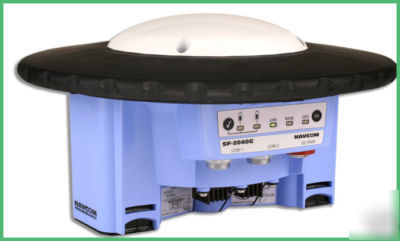
Reduced to sale navcom SF2040G gps great units
NAVCOM StarFire SF-2040G DEMO Unit for Sale with Extras...
Bargain Price: $8,500X Reduced $6,500.00
Standalone DGPS decimeter, RTK Extend, GSM or UHF ready plus bluetooth available
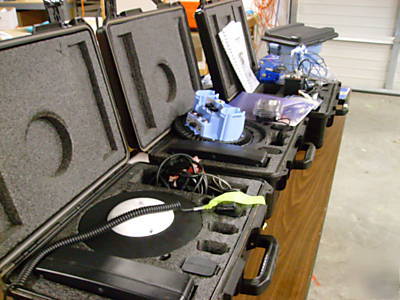
Includes Hardcase, batteries, software and a special bonus! The RTK module has been activated, RTK Extend "ON" units have been checked out by NAVCOM and certified can be used as a Rover or a Base. Its not hard to see how outstanding this deal is for the GPS professional and or land surveyor.
decimeter accuracy with STARFIRE or sub-centimeter RTK...plus use a a STATIC receiver and send to OPUS
YOU JUST CAN'T BEAT THIS DEAL, GREAT UNITS TO START OUT WITH OR ADD TO AN EXISTING SYSTEM
The first of its kind, this global satellite-based augmentation system (GSBAS) provides decimeter positioning accuracy on a worldwide basis, completely independent of geographical boundaries, allowing users to roam freely while maintaining the most precise positioning information.
SF-2050G Navcom with accessories and cables
*Two of each (SF-2040G/ SF-2050G) in Stock
NAVCOM Starfire SF-2040G Demo Unit
(Carlson Explorer pictured, not included in this listing. However, available at anytime.)
NavCom offers two types of StarFire services, StarFire Subscription Service and StarFire Reference Data.
NAVCOM Subscription Service Available for Data Collection
The StarFire global subscription service provides real-time accuracy typically better than 10cm (4 inches). Its globally corrected signal is available virtually anywhere on the Earth's surface on land or sea, from 76 N to 76 S latitude.
To accomplish this, StarFire utilizes a network of more than 60 GPS reference stations around the world to compute GPS satellite orbit and clock corrections. Two completely redundant processing centers and multiple communication links ensure the continuous availability of StarFire GPS corrections. These corrections are broadcast via three geostationary satellites, providing worldwide coverage and enabling precise real-time navigation without the need for local ground base stations.
The StarFire Network is a major advance from earlier ground-based augmentation systems because it considers each of the GPS satellite signal error sources independently. GPS satellite orbit and clock corrections are calculated from a global tracking network of dual-frequency receivers; these corrections are transmitted via Inmarsat satellite links directly to StarFire receivers, resulting in worldwide operation and minimal data latency. All StarFire dual-frequency GPS receivers measure the ionospheric delay for each satellite; tropospheric zenith delays are calculated from a multi-state time and position model aided by redundant satellite observables.
http://palmettoequipment.googlepages.com/STARFIRE_GPS.jpg
As a Global Satellite-Based Augmentation System (GSBAS), the StarFire Network holds a significant advantage over differential GPS (dGPS) systems. Since no base station is required, the StarFire user is free to roam, with no limitations on range. StarFire provides one set of corrections for the entire world, as opposed to dGPS systems baseline-dependent regional corrections, which are geographically limited.
Learn more about GSBAS vs. dGPS systems.
In order to evaluate the satellite positioning options available, the primary error sources contributing to the corrections need to be understood.
Reference and rover errors include:
How these are handled can be placed into two broad classes: differential GPS (dGPS) systems and Global Satellite-Based Augmentation System (GSBAS) systems.
dGPS provides relative positioning; these positioning options determine corrections at the Earth s surface, either at individual sites or averaged over a region. These corrections are an amalgam of primary reference error sources and are transmitted to the user via radio or satellite link. User coordinates are determined relative to the reference site(s). Accuracy degrades with distance from the individual reference site or the regional boundary, primarily because of differential ionospheric and tropospheric effects, satellite orbits, and clocks. Examples of correction services include:
Widelane RTK is a relative newcomer, which is only available in the few areas of the world that require high accuracy on a regular basis for oil and gas exploration surveys.
Importantly, GSBAS systems provide absolute positioning, meaning they do not determine position relative to some fixed point of the Earth s surface. Instead, they determine a position within a space-based reference frame, thus they may also be considered to be within the Space Domain group.
Satellite communication links are used for some dGPS systems, so the term GSBAS does not relate to the communication link used but instead describes the nature of the corrections, i.e. that they are for the satellites. This class includes:
Augmentation for Standalone GPS consists of satellite orbit and clock updates which are generated by the GPS Ground Control Segment and distributed to the user with an ionospheric model in the GPS signal structure. It is this basic principle of determining each error source instead of amalgamating them which distinguishes GSBAS from dGPS.
Figure 1 shows the GSBAS and StarFire service areas and the global reference stations that are used for the StarFire system. The reference network infrastructure, quality of hardware, algorithm sophistication, and the speed at which this is accomplished all contribute to the robust positioning accuracy attained by the user.